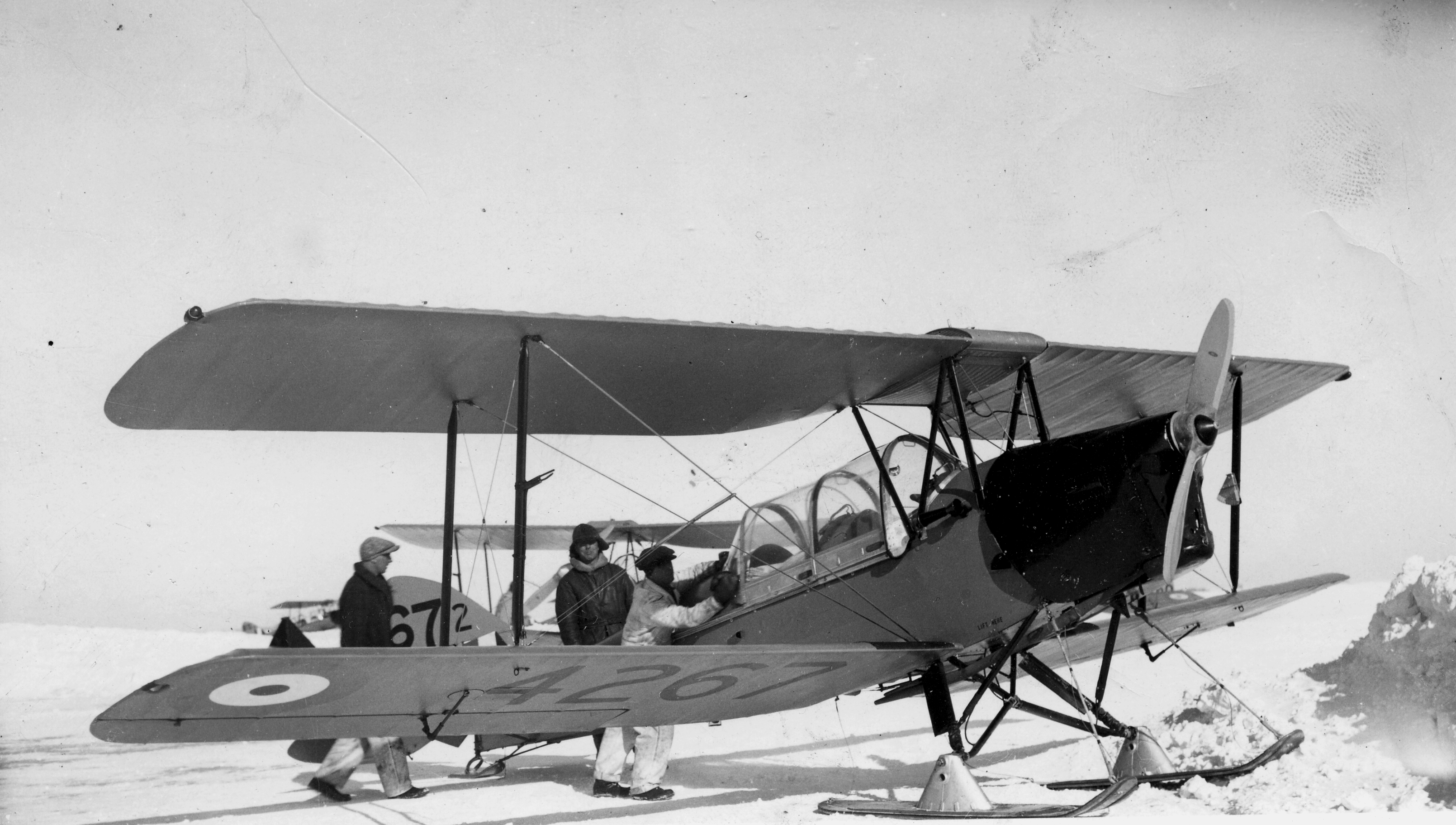
Bob landed at Brandon at about noon and taxied to the Commonwealth
Air Training Plan Museum (CATPM) at the airport. www.airmuseum.ca
At the time, the museum's Fairchild Cornell trainer was on the ramp giving
museum volunteers rides.
Museum president John McNarry, and Stephen Hayter, the general manager
were on hand to meet him.
"When I arrived, John McNarry came over and asked me 'Does your Tiger
always sound like that?” recalls Bob. "I didn't know what he meant, but
when I took off my headset I could hear quite a racket. There was a large
knock coming from the engine of the Tiger."
"It sounded serious and we needed to check it out. The first thing I
did was call Cecil Pittman up in Neepawa to tell him that the aircraft
was 'sick' and unlikely to make it to the community celebration he had
planned in Neepawa for Sunday."
The aircraft was pulled into the hangar at the museum and Bob and John
started removing the cowlings to get access to the engine. They suspected
a bearing problem, but wouldn't know for sure until they got access to
the inside of the engine.
While they were working, Brent Fitzpatrick from CKX TV, a CTV affiliate
station showed up to report on Bob's flight and the latest challenge in
the journey.
When Bob got to the RV park that night he was absolutely bushed. It
had been a long day of flying and trouble shooting, and he was still uncertain
as to the problem.
Sunday June 27
The original plan for Sunday was a short flight to Neepawa where Bob's
aircraft was stationed during the later part of the war with No. 35 (RAF)
and No. 26 Elementary Flying Training School. Local historian Cecil Pittman
had been corresponding with Bob for several years, and had mobilized the
community for the homecoming of the Tiger Moth.
Instead, Bob and McNarry were in the hangar at Brandon trying to tear
down the engine. They reached an impasse when they discovered they could
make no further progress without a special tool to pull the propeller hub
of the D.H. Gipsy Major 1C engine.
The publicity of the Tiger Moth flight across the Prairies and the aircraft's
arrival in Brandon stimulated considerable community interest, and the
Tiger Moth received a steady flow of visitors while on display at the Brandon
museum.
While they were working on Sunday, Archie Londry, past president of
the Museum, visited the hangar with his logbook. In Bob's presence, he
opened to the page where he had flown Tiger Moth No. 3874 at No. 19 EFTS
at Virden in December 1942.
Monday June 28
"Monday was an incredible day," says Bob Laidlaw.
"When I got up in the morning, I called Ed Clark, my engine man in Hawthorne,
California for advice. Ed rebuilt my engine and confirms that we need a
special tool to pull the propeller hub."
"John McNarry teaches machine shop at a local college. On hearing this,
he goes down to the college, which is closed for the summer, and he spends
the next five hours making the tool we need!"
"We took it back to the airport and got the hub off. You need to get
the hub off, to remove a seal, which sets off a chain reaction of parts
and allows you to remove the top cover of the engine."
“The whole exercise was anticlimactic because we got the top off and
couldn't find a darn thing wrong with the engine.”
Tuesday, June 29
Bob and John worked on the engine the entire day. They put it back together,
and by Tuesday night were ready to do some ground runs on the ramp at Brandon.
Bob started the engine and it ran as rough as ever.
Wednesday, June 30
The next morning, a local Aircraft Maintenance Engineer (AME) inspects
the engine with a bore scope but is unable to determine the problem. Visitors
speculate that it might be a connecting rod, or a pin or a misfiring cylinder.
“We were working the problem too much,” said Bob “and we needed to step
back and take a large view of the problem.
“We didn’t know what was wrong with the engine, and we were unable to
find out what the problem was by tearing the engine apart. We were not
in a environment conducive to figuring out the problem, and we were up
against a holiday weekend if we wanted to have parts couriered from the
United States.
“Ed Clark reminded me that the Gipsy Major in the aircraft is 80 years
old, and there are not too many people around who know how to fix one.”
“Even if we change parts in the engine, or got another engine,
we still had to fly across the wilds of northern Ontario to get to Toronto.”
“It would be nice to make this journey home to Toronto by air, but the
most important objective was to get the aircraft to Toronto in one piece
and on time.”
“I reviewed the situation, and decided that the aircraft better make
the rest of the trip to Toronto by truck or train,” said Bob Laidlaw.
Bob called Paul Cabot at the Toronto Aerospace Museum and told him to
start getting quotes to have the aircraft shipped from Brandon to Toronto.
Thursday, July 1
Bob Laidlaw and his wife Nell were invited to Neepawa to participate
in Canada Day celebrations. They met Cecil Pittman, whose grandfather had
the farm adjacent to RAF Station Neepawa.
Cecil has done a lot of work to commemorate the history of the flying
school in the town. Bob and Nell were shown a granite memorial bench in
front of the courthouse in the town, and they visited the local cemetery
were seven airmen killed in wartime accidents at the station are buried.
Bob and Nell were treated royally by the town, and attended the annual
community BBQ and shook lots of hands. Bob also made a courtesy visit to
the local nursing home to visit a local RCAF veteran who had flown Tiger
Moths during the war at No. 26 EFTS. He pulled out his logbook, but
they didn’t find No. 3874 listed, but a sister ship No. 3882.
Impressed with the hospitality, Bob invited Cecil and the folks of Neepawa
to visit Brandon and see the aircraft on Friday and Saturday before he
started dismantling the aircraft for its journey by surface means to Toronto.
Calling back to Toronto, Bob alerted the Toronto Aerospace Museum of
his desire to fly the Tiger Moth in Toronto if the loan of an Gipsy Major
1C engine could be arranged.
Friday and Saturday July 2-3
Publicity during the week brought at lot of visitors from Neepawa and
other communities to the museum in Brandon to see the Tiger Moth. Bob spent
a solid two days meeting visitors and telling the story of the Tiger Moth,
and his flight again (and again).
Sunday July 4
A decision was made to ship the aircraft to Toronto by CN inter-modal.
CN would send a truck and 43 ft long trailer to Brandon to pick up the
aircraft, and the trailer would be loaded on a railway car in Winnipeg
for the rail journey to Toronto.
Bob, John and a group of volunteers began dismantling the aircraft of
Sunday morning so it would be ready to load in the trailer on Monday morning.